
Reviewed · BAKU OLD CITY TOURS
Guided Old City Tour on Baku’s Timeless Charm
Baku’s oldest streets tell more than stone can. This two-hour walking tour through Icherisheher, Baku’s UNESCO-listed Inner City, packs medieval gates, caravanserais, mosques, baths, artists’ studios, and major landmarks into a compact route. I like the strong mix of famous sights and lesser-known architectural details, and I like that the group is capped at 15 people, small enough for questions without paying private-tour prices. The main drawback is pace: with 18 stops in about two hours, several places receive only a quick look.
At $25 per person, this is a sensible introduction to Baku if you want historical context before exploring on your own. The Maiden Tower and Shirvanshahs’ Palace require extra admission, and the price does not include fees or taxes, so budget for those separately if you plan to enter.
In This Review
- Key points at a glance
- Why Baku’s Old City works so well on foot
- Caravanserais reveal Baku’s trading past
- The Maiden Tower is the tour’s big landmark
- Archaeology, faith, and medieval daily life
- A corridor of caravanserais and baths
- Poetry, tiny books, and a working artist
- The Shirvanshahs’ Palace deserves extra time
- Final stops along the fortress walls
- What the $25 price really buys you
- Who should book this walk?
- Should you book the Baku Old City Tour?
- FAQ
- Where does the Baku Old City Tour begin?
- Where does the tour end?
- How long does the experience last?
- What is included in the price?
- Are entrance fees included?
- How large is the tour group?
- Can I cancel for a full refund?
Key points at a glance
- A fast route through 18 Old City sights: You see major monuments along with medieval baths, caravanserais, fortress walls, and small cultural sites.
- The UNESCO-listed core of Baku: Icherisheher provides the setting, with cobbled lanes and surviving defensive architecture.
- Two major ticketed sights: Entry to the Maiden Tower and Shirvanshahs’ Palace is not included.
- A maximum of 15 people: The group limit should make it easier to hear the guide and ask questions.
- A $25 starting price: The tour offers good orientation value, especially on a first visit to Baku.
- A central meeting point: The walk begins and ends at Gosha Gala Square on Kichik Qala Street.
Why Baku’s Old City works so well on foot
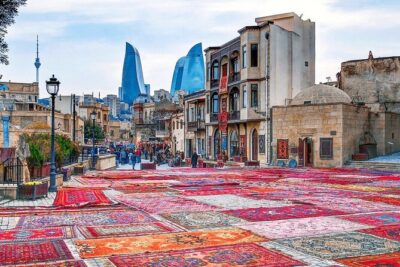
Baku’s Inner City is compact, but it is not a single-period museum piece. Its walls, religious buildings, merchant courtyards, baths, and later monuments sit close together, showing how the city served as a fortified settlement and a trading center.
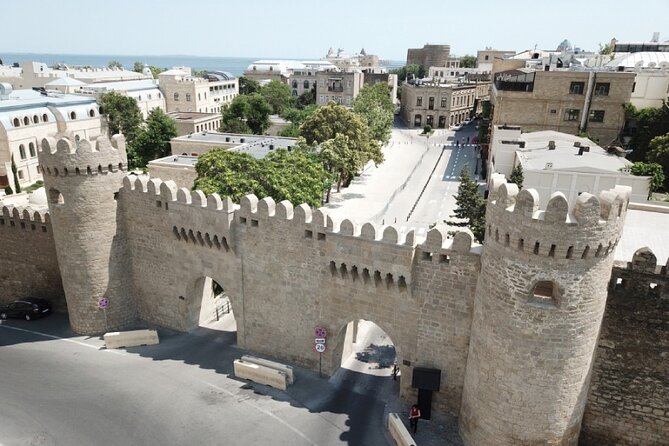
The route begins at Gosha Gala Square, beside the Double Gates of Baku. These gates date to the 12th century and formed part of the city’s defenses. They are an excellent starting point because they give you an immediate sense of entering a protected medieval quarter rather than simply walking into another city neighborhood.
I like tours that begin with the physical boundary of a place. Here, the gate helps explain the Old City before the guide starts naming buildings. It also gives you a useful reference point for returning later, since the walk ends in the same general area.
The tour is listed as approximately two hours, with daily operating hours from 10 a.m. to 6 p.m. The exact departure time should be confirmed when booking, but the stated meeting place is clear: Gosha Gala Square, 47 Kichik Qala, Baku.
More walks through the Old City:
- Baku Oil Heritage & Old Town Walking Tour
★ 5.0 · 232 reviews - Guba Khinalug & Candy Cane Mountains tour (by Old City Tours)
★ 4.5 · 208 reviews - Gabala + Shamakhi tour (by Old City Tours)
★ 4.5 · 198 reviews
Caravanserais reveal Baku’s trading past
Two early stops are the Bukhara Caravanserai and the Multani Caravanserai. These buildings are easy to miss if you walk through the Old City without a guide, since their courtyards and arcades can look like ordinary architectural remnants at first glance.
The Bukhara Caravanserai was built at the end of the 15th century along the Old City’s commercial road. Its square courtyard, raised entrance portal, surrounding balconies, and private rooms show how merchants and other visitors were housed after a day of trade. The courtyard was not merely decorative. It served as a meeting place and open-air hall.
The building was restored in 1964, a detail worth knowing when you are looking at the stonework. Restoration can make an old structure easier to read, but it also means you are seeing a building shaped by both its original period and later preservation work.
Opposite it, the Multani Caravanserai dates to the 14th century. It housed merchants from Multan, now in Punjab, Pakistan. The connection points to the long-distance trade routes that linked Baku with areas far beyond the Caucasus.
The Multani site also has a connection with Zoroastrian merchants, who are associated with the Ateshgah Temple at Surakhani. That detail adds another layer to the city’s religious and commercial past without requiring a separate trip outside Baku.
Both caravanserais receive only about two minutes in the published schedule. Think of them as guided orientation stops rather than long visits. If you want photographs, pause quickly and keep moving.
The Maiden Tower is the tour’s big landmark
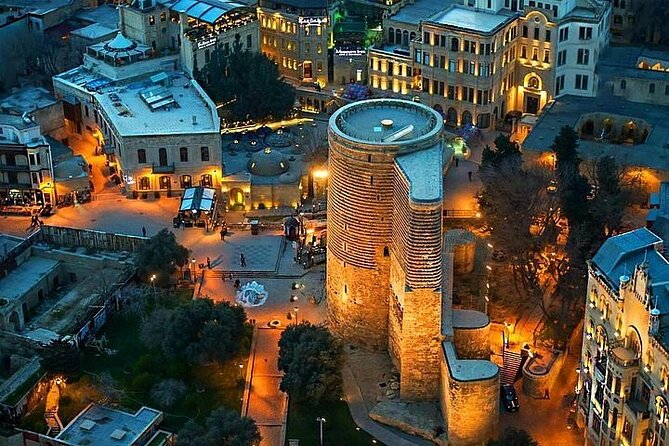
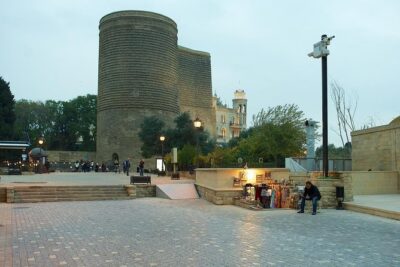
The Maiden Tower receives about 10 minutes, making it one of the longer early stops. It is a 12th-century monument and one of Azerbaijan’s best-known national symbols. Along with the Shirvanshahs’ Palace, it forms part of the UNESCO-listed historic ensemble.
The tower’s purpose and origins have been debated. Some interpretations connect it with Zoroastrianism and pre-Islamic architecture in Iran and Azerbaijan. A good guide can help separate established facts from competing theories, which is especially useful here because the tower has attracted many legends.
Admission is not included. That matters because a 10-minute stop may mean viewing the exterior only unless you arrange to enter and allow extra time. The tour price remains reasonable, but you should not assume that the $25 covers every major attraction on the route.
I would treat the Maiden Tower as a place to listen closely and take in the setting. Its value is not just the structure itself. The surrounding streets, nearby archaeological remains, and position within the fortified city help explain why it became such a strong emblem of Baku.
Archaeology, faith, and medieval daily life
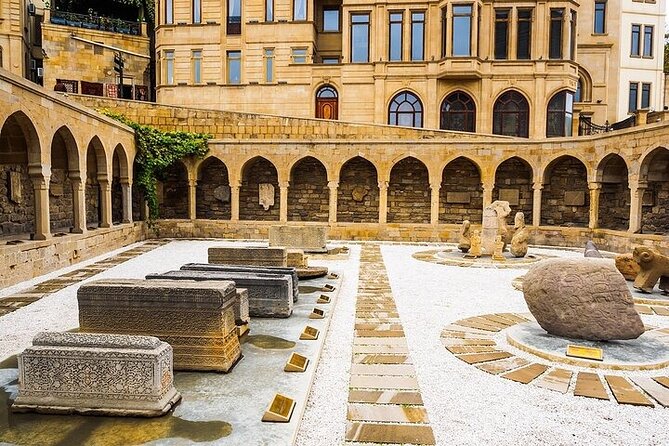
Near the Maiden Tower, the route passes Bazar Square, also known as the Khanqah complex. This 12th or 13th-century religious and architectural complex includes an arcade and was uncovered during archaeological work in 1964.
It is a short three-minute stop, but it helps show that the Old City was not built only around palaces and defenses. Religious activity, commerce, and ordinary movement through public spaces were closely linked.
The nearby St. Bartholomew Church offers a different view of Baku’s religious past. Built in 1892 with donations from the local Christian community, it stood on a site associated with the apostle Bartholomew. The small Russian-style Orthodox church operated until 1936, when it was demolished during the campaign against religion.
The stop is brief, about three minutes. You may not see a complete surviving church building, so the value lies in the story of what once occupied the site and in the contrast with the Islamic and pre-Islamic layers around it.
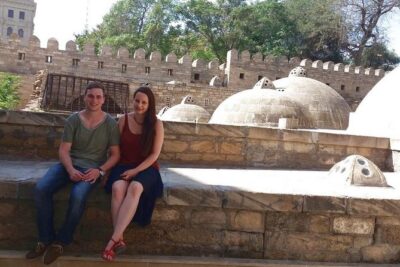
The Haji Ghayib, or Haji Bani, Bath is another worthwhile stop. Built at the end of the 15th century, it was discovered underground during archaeological research in 1964. Its location along a caravan route reflects the practical role of public baths in Muslim cities.
The building’s rooms have carefully shaped vaults and coverings. Even a short look can help you picture how water, heat, changing areas, and bathing spaces were organized. The schedule allows five minutes here, one of the longer pauses among the smaller monuments.
More ways to see the city in a day:
- From Baku: Gabala and Shamakhi Tour (Free Baku City Tour)
★ 4.8 · 695 reviews - Old and Modern Baku Tour ( Day & Night Time)
★ 5.0 · 400 reviews - City Tour in Baku
★ 5.0 · 180 reviews - The Best Baku City Tour
★ 5.0 · 131 reviews
A corridor of caravanserais and baths
The middle portion of the walk continues through buildings tied to trade and public life. The two-story Gasim Bey Caravanserai, also called the Gasim Bey Caravanserai, dates to the 15th century. It may have been built during the reign of Shirvanshah I Khalilullah and later assigned to Gasim Bey and his heirs after Baku became part of the Russian Empire.
This is a good example of how buildings can change purpose and ownership as political control shifts. The stop lasts about three minutes, so listen for the building’s role rather than expecting a full interior visit.
The Juma Mosque, or Friday Mosque, has a long and layered building history. An inscription refers to its restoration in 1309, and a minaret was added in 1437. The present mosque was built in 1899 with funding from Baku merchant and philanthropist Haji Shikhlali Dadashov.
The site also contains traces of a Zoroastrian temple. That combination is typical of the Old City’s appeal: one location may hold evidence from several religious and political periods. The scheduled five minutes gives the guide time to explain the main points, though not necessarily to explore every architectural detail.
The Small Caravanserai is a 12th-century structure with a square plan, an inner courtyard, rounded corners, and a long surrounding balcony. Its north and south entrances are shaped as portals, while the southern side has a defensive two-story design. The former sea entrance is another reminder that Baku’s relationship with the Caspian shaped its trade.
The Gasim Bey Bath dates to the 17th century and is also called the Sweet Bath because bathers were served sweets with tea. Its plan included an entrance, changing room, bathing areas, pools, and a boiler room. Ceramic pipes in the walls and beneath the floor helped supply water and heat the building.
It was reconstructed in 1970 and later became a pharmacy known as the Green Pharmacy. That change makes it a useful stop for understanding how historic buildings survive by taking on new uses.
Agha Mikayil Bath dates to the 18th century and remains a functioning bath after restoration in 2010. It differs from other baths on the route through its large interior and square changing and bathing rooms. Pointed arches, domes, and a chimney shape the building’s appearance.
The bath is on Kichik Gala Street, one of the Old City’s main streets. The three-minute stop is quick, but the fact that it still functions gives it particular interest. You are not only looking at a preserved shell. You are seeing a building type that remains connected to its original purpose.
Poetry, tiny books, and a working artist
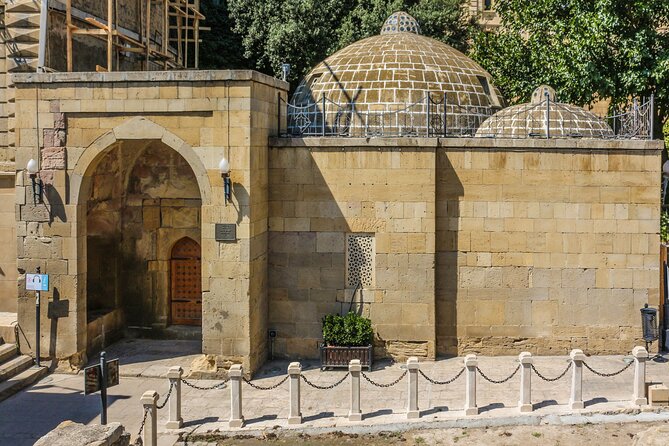
The Aliagha Vahid Monument honors the Azerbaijani poet and ghazal singer Aliagha Vahid, who lived from 1895 to 1965. The monument was designed and sculpted by Rahib Hasanov, with Sanan Salamzade as architect, and was completed in 1990.
This brief stop adds modern Azerbaijani cultural identity to a route otherwise dominated by medieval architecture. It is a reminder that the Old City is still part of present-day Baku, not simply a preserved historical zone.
The Baku Museum of Miniature Books is one of the route’s more unusual stops. It opened in 2002 and holds more than 6,500 books from 64 countries, collected by Zarifa Salahova over 30 years. In 2015, it received a Guinness World Records certificate as the largest private museum of miniature books.
The tour allows about 10 minutes here. That is enough for a quick look, though anyone fascinated by book history may want to return independently. The museum’s purpose includes encouraging childhood literacy, giving the collection a social purpose beyond its record-setting scale.
The Workshop Ali Shamsi provides another change of pace. It is an art studio and public attraction presenting the work of Azerbaijani artist Ali Shamsi. He studied at an arts-focused boarding school, graduated from the Azerbaijan State Institute of Arts in 1985, and later spent time near Kharkiv painting icons in a monastery.
The studio is scheduled for 10 minutes. Since it is a working artistic space rather than a large formal museum, the experience may depend on what is open and on how much time the guide can give it. Still, it is one of the route’s more personal stops.
The Shirvanshahs’ Palace deserves extra time
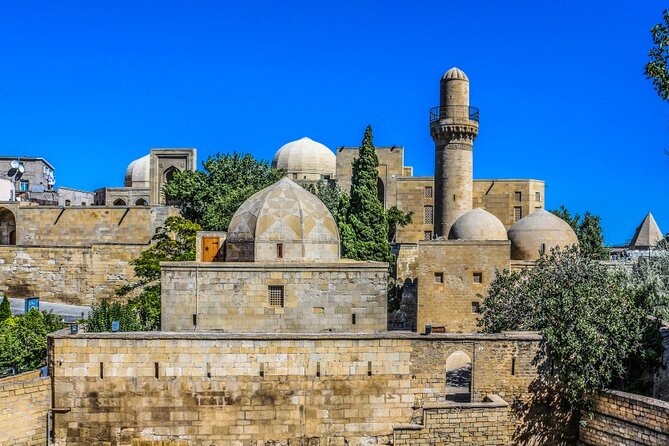
The Palace of the Shirvanshahs is the tour’s most important architectural stop after the Maiden Tower. Built in the 15th century, it was commissioned after the Shirvanshah dynasty moved its capital from Shemakha to Baku following a devastating earthquake.
The palace is described by UNESCO as one of Azerbaijan’s finest architectural works. The complex forms a historic ensemble with the Maiden Tower and helps explain the political importance of Baku during the Shirvanshah period.
The schedule allows 20 minutes, the longest stop on the tour. Admission is not included, so check the entry cost and opening conditions before you go if you want to see the interior areas. Twenty minutes is useful for a first look, but the complex is the place most likely to deserve a return visit.
I would pay close attention to the relationship between the palace and the surrounding fortress streets. The building is not an isolated royal residence. It sits inside the same compact urban fabric as mosques, baths, trading courtyards, and defensive walls.
Final stops along the fortress walls
The Beyler Mosque sits opposite the Murad Gate of the Shirvanshahs’ Palace complex. It is listed as a historical and architectural monument of national importance. The stop lasts two minutes, so expect a short exterior explanation rather than an extended visit.
The final major architectural sight is the Quadrangular Tower. Baku’s medieval defenses once included two large fortress walls on the north, east, and west sides. After repeated repairs and a final restoration in the 1950s, 25 semicircular towers and one quadrangular tower remained.
The distinction between the rounded towers and the single quadrangular structure gives the guide a clear way to explain the city’s defensive system. The three-minute stop also brings the tour back toward its starting point.
The activity ends at the meeting point. That is convenient if you want to continue exploring the Old City, return to a nearby hotel, or use the gates as a fixed reference for the rest of your day.
What the $25 price really buys you
At $25, the main value is the guide’s interpretation and the efficient route. Most of the listed stops do not charge admission, but the tour price excludes all fees and taxes, and entry to the Maiden Tower and Shirvanshahs’ Palace is specifically not included.
You are paying for a structured introduction, not a full-day museum experience. The route covers a great deal in two hours, but many stops last only two or three minutes. That is ideal if you want a first orientation. It is less suitable if you prefer slow photography, long interior visits, or detailed architectural study.
The group limit of 15 is a useful middle ground. It should feel more manageable than a large coach group, while remaining cheaper than a private guide. The professional guide is included, and the mobile ticket makes access simple.
The four available ratings are uniformly positive, with an overall rating of 5. The strongest praise centers on careful organization, good timing, competitive pricing, and guides who explain local culture and history clearly. One note names Vahid in connection with a carefully planned excursion, but the available information does not confirm that he leads this specific Old City route, so I would not book based on a promised guide name.
Who should book this walk?
I would recommend it to you if this is your first time in Baku and you want the Old City explained rather than simply photographed. It also suits families and mixed-age groups, since the route is short, central, and focused on varied sights.
It may not suit you if you want to enter every monument, spend long periods at the palace, or explore at a relaxed pace. In that case, use this walk as an introduction, then return independently to the Maiden Tower, Shirvanshahs’ Palace, the miniature book museum, or the baths that interest you most.
Most people can participate, service animals are allowed, and the route is near public transportation. The tour operates Monday through Sunday between 10 a.m. and 6 p.m. Free cancellation is available up to 24 hours before the start time. Within 24 hours, the payment is not refunded, and the activity requires a minimum number of participants.
Should you book the Baku Old City Tour?
Book it if you value clear orientation, a compact route, and strong value at $25. The mix of major landmarks, caravanserais, baths, religious sites, and local art gives you a better sense of Baku than a walk focused only on the Maiden Tower and palace.
Before booking, decide if you are comfortable paying extra admission and moving quickly. If yes, this is a practical first walk through Icherisheher. If you want a slower, more detailed study of the major monuments, book the tour for context, then set aside another half-day to revisit the sites that catch your eye.
FAQ
Where does the Baku Old City Tour begin?
It begins at Gosha Gala Square, 47 Kichik Qala, Baku, Azerbaijan.
Where does the tour end?
The tour ends back at the meeting point.
How long does the experience last?
The walking tour lasts approximately two hours.
What is included in the price?
A professional tour guide is included. The activity also provides a mobile ticket.
Are entrance fees included?
No. All fees and taxes are excluded, and admission to the Maiden Tower and Shirvanshahs’ Palace is not included.
How large is the tour group?
The activity has a maximum of 15 participants.
Can I cancel for a full refund?
Yes, if you cancel at least 24 hours before the experience start time. Cancellations made less than 24 hours before the start time are not refunded.
Recently added around Baku
- Heartbeat of Baku: Old & Modern City Walk (Group or Private)★ 5.0 · 3 reviews
- Baku: Secret Tour with Surprise Activity★ 5.0 · 3 reviews
- From Baku: Shahdag Mountain Resort Day Trip★ 5.0 · 3 reviews
- Full Day Guided Tour of Shamakhi and Gabala★ 5.0 · 3 reviews
- Guba and Khinaligh Private Tour★ 5.0 · 3 reviews
- Guba and Shahdag Tour with Guide★ 5.0 · 3 reviews
- Lahij – village of masters★ 4.5 · 3 reviews
- Gobustan & Mud Volcano★ 4.5 · 3 reviews
Baku Old City Tours, compared.
Guba Khinalug & Candy Cane Mountains tour (by Old City Tours)
Read our review →
Baku Old City Tour (officially by Old City Tours)
Read our review →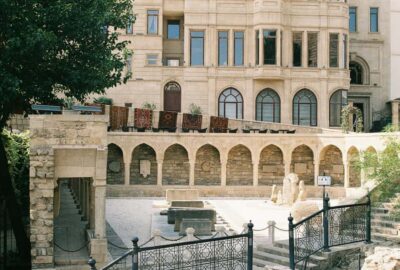
Baku Old City Wonders: A Walking Tour Through Time
Read our review →Browse the lists this tour appears in