
Reviewed · GOBUSTAN & MUD VOLCANO TOURS
Full day Gobustan & Absheron Tour (Group or Private)
Mud volcanoes, ancient carvings, and living fire await. This eight-hour trip from Baku packs several of Azerbaijan’s most unusual sights into one day, from the bubbling mud fields of Gobustan to the gas flames of Yanar Dag. I like the way it combines natural oddities with serious archaeology, and I like that transport and an English or Russian guide are included for $30 per person. The catch is that entrance fees and lunch cost extra, and nearly four hours of the day go by in the vehicle.
You begin near Baku’s Old City and return there after a broad loop through Gobustan and the Absheron Peninsula. The group can be as large as 17 people, so the price is attractive, but the experience will feel less personal than a private car. It is a strong choice if you want to see far-flung sights without arranging several separate rides.
In This Review
- Key points at a glance
- Why this makes a good Baku day trip
- Starting at Baku’s Double Gates
- Mud volcanoes and the off-road ride
- Reading 6,000 ancient petroglyphs at Gobustan
- The modern Gobustan museum
- Lunch in the Absheron Region
- Bibi-Heybat Mosque beside the Caspian Sea
- Ateshgah, the fire temple of Absheron
- Yanar Dag and the burning hillside
- Time on the road and group size
- What the $30 price really buys
- Who should book this tour?
- Should you book it?
- FAQ
- How long does the Gobustan and Absheron tour last?
- Where does the tour start?
- Is lunch included?
- Are entrance fees included in the tour price?
- What languages does the guide speak?
- How many people can join the group?
- What happens if bad weather cancels the tour?
Key points at a glance
- The mud volcano ride is the day’s wild card: A short off-road journey in a Lada takes you toward the mud pots, an unusual detail that makes this stop more memorable than a simple roadside viewpoint.
- Gobustan offers two different experiences: You see the open-air petroglyph reserve, then visit a modern museum with interactive displays and archaeological material.
- The tour links fire, faith, and geology: Ateshgah Fire Temple explains religious fire worship, while Yanar Dag shows natural gas burning from the ground.
- Bibi-Heybat adds a religious stop: The mosque gives the day a cultural and architectural pause beside the Caspian shoreline.
- Expect extra costs: Lunch and admission to the mud volcano complex, Gobustan sites, Ateshgah, and Yanar Dag are not included.
- The schedule is full but manageable: The tour begins around 9 a.m., lasts about eight hours, and includes roughly three hours and 40 minutes of driving.
Why this makes a good Baku day trip
Baku is modern, compact, and easy to explore on foot, but some of Azerbaijan’s most striking sights sit well outside the center. Gobustan lies south of the city, while the Absheron sites spread east and west across the peninsula. Booking one day of transport lets you connect places that would be awkward to reach independently.
I especially like the range of the route. You are not spending eight hours looking at one type of monument. The day moves from prehistoric rock drawings to a working religious site, from a seaside mosque to a burning hillside. The result is a useful introduction to Azerbaijan’s natural forces and long human story.
The $30 price is good for a full day in an air-conditioned vehicle, particularly if you are traveling alone or as a couple. It also includes pickup and drop-off depending on where you stay, though the stated meeting point is the Old City Hub at the bus stop near the Double Gates. The low headline price needs a little adjustment once you add admission fees and lunch.
More Gobustan and mud volcano runs:
- Baku: Gobustan, Mud Volcano, Fire Mount, Temple Lunch Entry
★ 4.9 · 3,246 reviews - BEST Gobustan, Volcanoes & Absheron Fire Tour (Group or Private)
★ 5.0 · 1,254 reviews - Gobustan and Absheron tour (All inclusive)
★ 5.0 · 1,014 reviews
Starting at Baku’s Double Gates
The tour begins around 9 a.m. in front of Gosha Gala Gapisi, the Double Gates of Baku’s Old City. This is a practical central meeting point, and pickup from your accommodation may be available depending on its location. Confirm the exact arrangement before setting out so you know if you need to reach the Old City yourself.
The first scheduled stop is brief, about 15 minutes, and admission is free. Think of it as the launch point rather than a sightseeing stop. If you are staying near the Old City, allow time to find the correct bus stop, since the meeting point is described both by its local name and by a map code.
The return is to the same meeting point. That makes the day easy to fit around an evening meal or a short walk through the Old City, though the eight-hour estimate can shift with road conditions and time spent at each attraction.
Mud volcanoes and the off-road ride
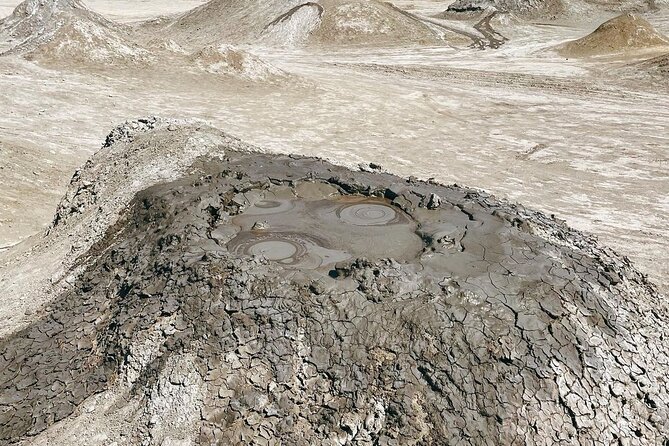
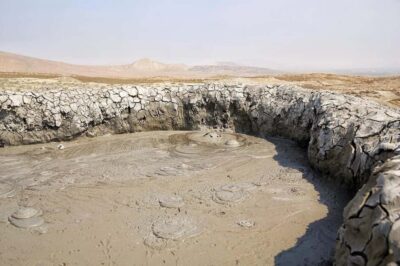
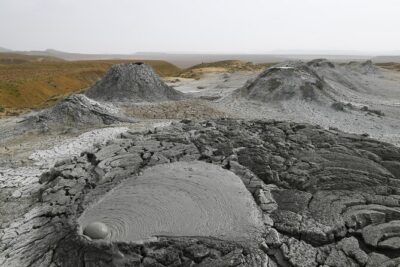
The mud volcanoes are one of the most unusual reasons to book this tour. Azerbaijan is famous for its many mud volcanoes, which form when underground gases and mud push upward through the earth. These are not the tall, fiery cones people often picture when they hear the word volcano. They are low, raw formations, often marked by small bubbling pools and cracked ground.
The listed visit lasts about 20 minutes, but the approach is part of the fun. A previous account of the excursion singled out the off-road trip in a Lada to the mud pots as the day’s highlight. That detail matters. You are not simply stepping out beside a paved highway and taking a quick photograph. The vehicle used for the rough approach gives the stop a more adventurous feel.
The mud volcano complex charges an extra entrance fee. The amount is not provided, so budget for it separately rather than assuming the $30 covers every stop. Conditions can also affect how much you see. The tour requires good weather, and the rough track may be less comfortable in poor conditions.
Keep this visit in perspective. The stop is short, and the formations are not presented as a polished attraction. Their appeal comes from the strange geology and the feeling of seeing something that looks almost unfinished. If you prefer museums and formal monuments, this may be your least comfortable stop. If you enjoy odd natural sights, it could be the part you remember most.
Reading 6,000 ancient petroglyphs at Gobustan
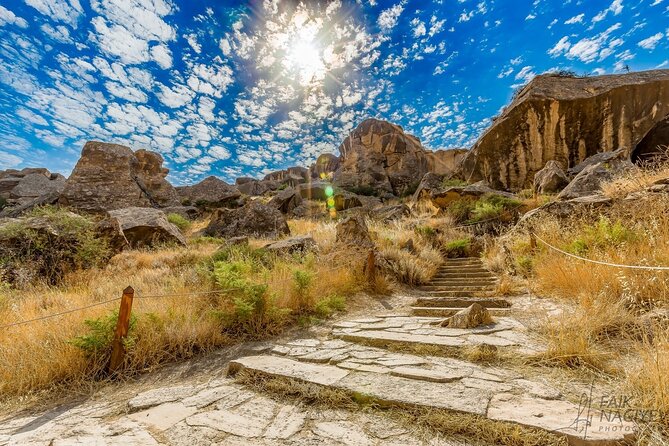
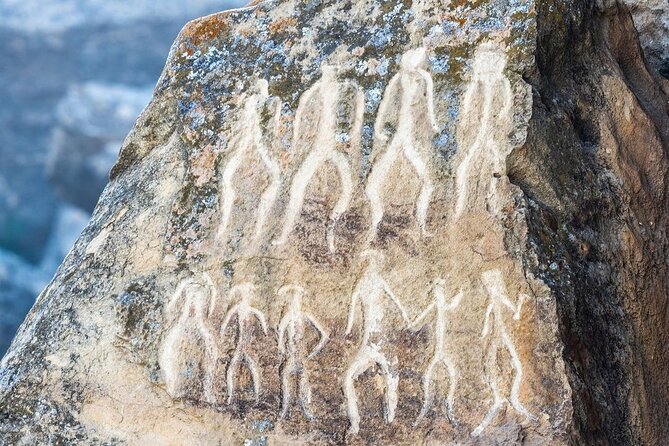
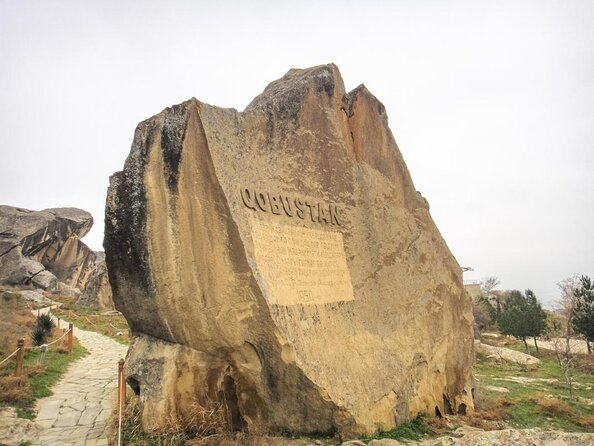
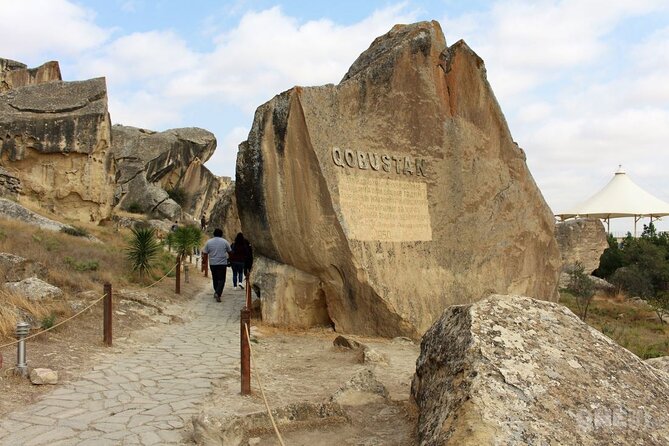
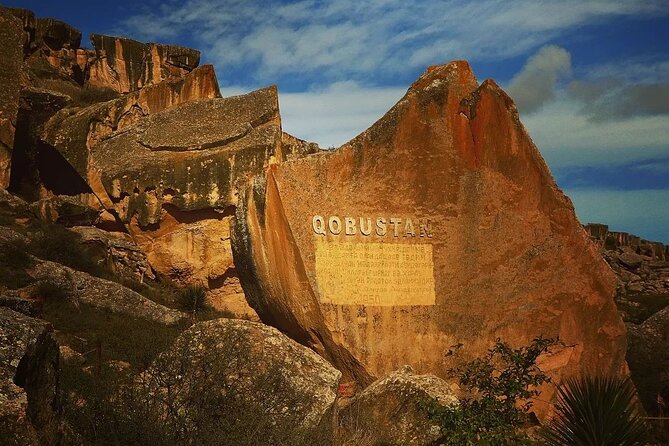
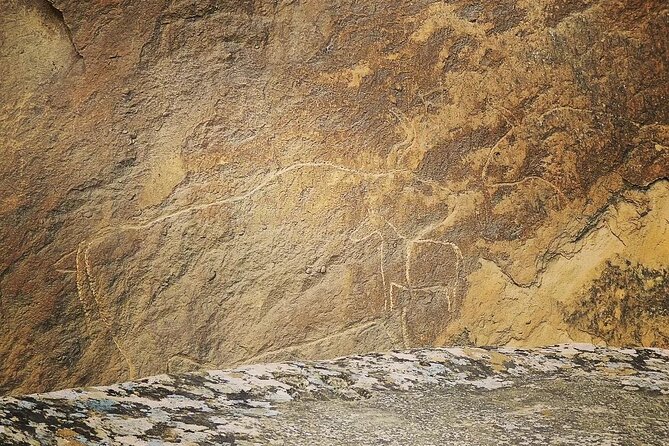
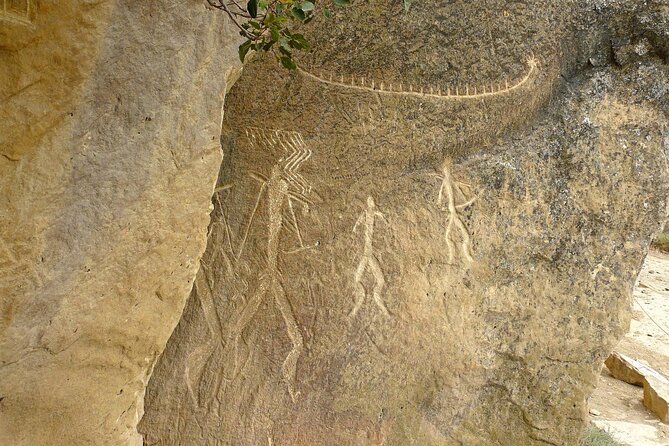
Gobustan State Reserve is the cultural center of the day. More than 6,000 petroglyphs are spread across the reserve, with images of people, animals, warriors, boats, hunting scenes, dances, camel caravans, and other details of early life. The carvings date from roughly 5,000 to 20,000 years ago.
That range is what gives Gobustan its force. You are not looking at a single isolated carving with no context. The images record changing ways of life over a very long period. They offer clues about movement, ceremony, hunting, and the way early communities understood the world around them.
The visit to the rock art lasts about 40 minutes. That is enough for an introduction and a selection of the main carvings, but not enough for a slow, independent study of every panel. Stay close to the guide and ask questions as you go. Without explanation, some petroglyphs may be hard to spot or interpret.
The reserve also includes musical stones, sometimes called resonant stones. These add another layer to the visit, showing that Gobustan is not only about pictures on rock. It also connects sound, ritual, and daily life in the ancient settlement area.
Admission is extra. Since the exact entrance price is not given, check the current amount before booking if you are watching every dollar. Still, this is the stop that gives the day its strongest historical value.
More Absheron peninsula circuits:
- Baku: Gobustan Absheron Tour Entry Tickets included
★ 4.9 · 329 reviews - Baku: Gobustan-Absheron Tour with Hotel PICK UP and DROP OFF
★ 4.8 · 170 reviews - Baku: Gobustan/Absheron guided tour with lunch and tickets
★ 4.8 · 158 reviews - Gobustan and Absheron peninsula ( Group or Private ) TOUR ( All inclusive )
★ 5.0 · 130 reviews
The modern Gobustan museum
After the open-air reserve, you visit a modern interactive museum complex. This second Gobustan stop lasts about 40 minutes and helps explain what you have just seen outside.
The museum holds more than 100,000 archaeological materials and presents items from the Paleolithic, Mesolithic, and Neolithic periods. Touchscreen displays provide information in several languages, while animated presentations and videos show how the area’s natural setting changed and where people lived over time.
I like this two-part arrangement. Rock art alone can feel distant, especially when you are trying to understand what a faint figure means. The museum supplies dates, maps, objects, and visual context. The entrance features petroglyphs resembling the Azerbaijani Yalli round dance, linking ancient imagery with a later cultural tradition.
The museum is also useful if the weather is harsh or the outdoor carvings are difficult to read. It does not replace the reserve, but it makes the visit more understandable. Admission is not included, so remember that Gobustan may involve a separate fee for the reserve and museum complex, or a combined charge depending on current local arrangements.
Lunch in the Absheron Region
The tour allows one hour for lunch at a traditional restaurant in the Absheron Region. Lunch is not included, which gives you control over what you spend, but it also means the final cost will be higher than the advertised price.
A one-hour meal is enough for a proper break after the morning’s driving and outdoor stops. It is also a practical chance to ask the guide about local dishes or clarify the afternoon schedule. Since no fixed menu or restaurant price is provided, bring enough money for your own meal and drinks.
This is not a food tour, so keep expectations focused. The value here is the pause. A full day with several sites and nearly four hours in a vehicle can feel tiring without a seated meal.
Bibi-Heybat Mosque beside the Caspian Sea
Bibi-Heybat Mosque offers a change of mood. The route follows the Caspian shoreline to this important religious site, where the present mosque was rebuilt in the 1990s after the earlier structure was lost. The original mosque dates to the 13th century.
The mosque contains the tomb of Ukeyma Khanum, described as a descendant of the Prophet Muhammad. That makes the site significant to worshippers as well as to people interested in Azerbaijan’s religious and architectural traditions.
The stop lasts about 20 minutes and admission is free. Because the visit is short, you should treat it as an exterior and cultural stop rather than a long architectural study. Dress and behave respectfully at a religious site, and follow any instructions about where you may walk or take photographs.
Bibi-Heybat also breaks up the geology and archaeology of the day. After mud, rock carvings, and museum displays, the mosque brings you back to living religious culture.
Ateshgah, the fire temple of Absheron
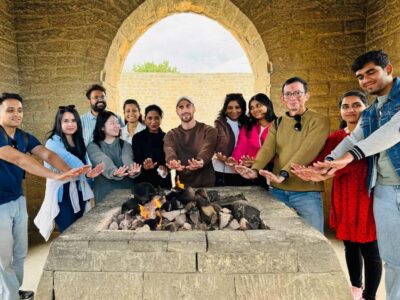
Ateshgah Fire Temple lies about 21 kilometers east of Baku. Its stone enclosure has the shape of a small fortress, with cells around a central shrine. Indian merchants built the temple in the 18th century, after natural gas rising from underground drew Hindu worshippers from the Ganges region.
The site is tied to an older tradition of fire worship. Natural gas once fed flames here, and worshippers lived an ascetic life in the surrounding cells. The temple therefore links geology with belief in a direct, visible way. The ground itself helped shape the religious importance of the place.
You have about 40 minutes here. That should allow time to inspect the courtyard, cells, central shrine, and interpretive material. The temple charges an additional admission fee.
Ateshgah is more than a pretty stone courtyard. It helps explain why fire has such a strong place in Azerbaijan’s cultural story. The country’s oil and gas resources are not only modern economic facts. They have affected settlement, legend, worship, and travel for centuries.
Yanar Dag and the burning hillside
Yanar Dag, or Burning Mountain, is the final major attraction. Natural gas escapes through fissures in the earth and burns at the surface, creating persistent flames along the hillside. The gas flows are linked to underground oil and gas layers, rock erosion, tectonic activity, and the area’s volcanic processes.
The visit lasts around 25 minutes. That is enough to see the flames, take photographs, and listen to an explanation of the geology. The stop is visually direct: you see fire coming from the ground rather than from a lamp, furnace, or ceremonial structure.
Yanar Dag works especially well after Ateshgah. At the temple, people built a place of worship around natural fire. At the burning hillside, you see the natural force itself. Together, the two stops explain the connection between Absheron’s geology and its spiritual traditions.
Admission is extra. Like the mud volcanoes, Yanar Dag is weather dependent, and the entire experience may be canceled if conditions are unsuitable. The policy allows a different date or a full refund in that case.
Time on the road and group size
The tour spends about three hours and 40 minutes in the vehicle while traveling to Gobustan, returning to Baku, and visiting the Absheron Peninsula. That is a large share of an eight-hour day, but the distances make sense. These attractions are scattered rather than clustered around central Baku.
The air-conditioned vehicle matters, especially during warm weather. You get a seat, shelter from the sun, and a guide who can explain the sights as the route unfolds. The maximum group size is 17 people. That keeps the price low, though boarding, photographs, and short stops may take longer with a full group.
A private option is likely the better fit if you want to linger at Gobustan, move quickly through the fire sites, or control your lunch timing. The group format is better for keeping the cost down and meeting other people, provided you are comfortable with a fixed schedule.
The tour offers English and Russian guiding. At booking, check that your preferred language is available on your date. Personal expenses are not included, and the provider lists service animals as allowed. Most people can take part, and the route is near public transportation at the starting point.
What the $30 price really buys
At $30 per person, this is an efficient way to reach several sites that would otherwise require separate taxis, a hired car, or careful public transport planning. The air-conditioned vehicle, guide, and possible pickup and drop-off provide the main value.
You should not treat $30 as the final all-in price. Add lunch, the mud volcano complex fee, Gobustan admission, Ateshgah admission, and Yanar Dag admission. The exact entrance amounts are not stated, so ask for current prices before departure if you need a precise budget.
The tour is recommended by all 19 recorded ratings and carries a five-star average. That is a small sample, but it supports the idea that the route delivers what it promises: a broad, unusual day outside Baku. The strongest appeal is not luxury. It is coverage.
Who should book this tour?
I would choose this trip if you have limited time in Baku and want to see more than the city center. It suits anyone interested in geology, archaeology, religious sites, photography, or the strange overlap of natural gas and ancient worship.
It is also useful for solo visitors, couples, and small groups who would pay much more to hire a car privately. Families may like the variety, though the long driving time and short visits could test young children.
I would hesitate if you want a slow day, a detailed archaeological study, or a food-focused outing. The schedule is broad and brisk. You see several important places, but you do not get unlimited time at any one of them.
Should you book it?
Book this tour if you want an affordable, well-packed introduction to Gobustan and Absheron. The off-road mud volcano visit, the 6,000-plus petroglyphs, and the two fire sites give you experiences that central Baku cannot provide.
Before booking, confirm the pickup point, guiding language, and current entrance fees. Choose the private version if flexibility matters more than price. Choose the group tour if your priority is reaching the far-flung sights efficiently, with transport and explanations handled for you.
FAQ
How long does the Gobustan and Absheron tour last?
The tour lasts approximately eight hours. It begins around 9 a.m. and returns to the Old City meeting point after visiting Gobustan, Bibi-Heybat Mosque, Ateshgah, and Yanar Dag.
Where does the tour start?
The stated meeting point is Old City Hub, at the bus stop near the Double Gates of Baku, also called Gosha Gala Gapisi. Pickup from your accommodation may be offered depending on its location.
Is lunch included?
No. You have about one hour for lunch at a traditional restaurant in the Absheron Region, but you pay for the meal yourself.
Are entrance fees included in the tour price?
No. Entrance fees for the mud volcano complex, Gobustan rock art sites, Ateshgah Fire Temple, and Yanar Dag are not included.
What languages does the guide speak?
Professional guiding is offered in English and Russian. Confirm your preferred language when booking.
How many people can join the group?
The activity has a maximum group size of 17 people. A private option is also available.
What happens if bad weather cancels the tour?
The experience requires good weather. If it is canceled because of poor conditions, you are offered a different date or a full refund. You can also cancel at least 24 hours before the start time for a full refund.
More Full-Day
- Full Day Sightseeing Tour of the main Attractions around Baku
★ 4.5 · 388 reviews - Sheki – Full Day Tour to Five Regions of Azerbaijan
★ 4.5 · 279 reviews - Full Day Trip in Baku (Gobustan & Absheron)
★ 5.0 · 72 reviews - Khizi Candy Mountains, Shahdagh Full Day Guided Tour
★ 4.5 · 61 reviews
Recently added around Baku
- Heartbeat of Baku: Old & Modern City Walk (Group or Private)★ 5.0 · 3 reviews
- Baku: Secret Tour with Surprise Activity★ 5.0 · 3 reviews
- From Baku: Shahdag Mountain Resort Day Trip★ 5.0 · 3 reviews
- Full Day Guided Tour of Shamakhi and Gabala★ 5.0 · 3 reviews
- Guba and Khinaligh Private Tour★ 5.0 · 3 reviews
- Guba and Shahdag Tour with Guide★ 5.0 · 3 reviews
- Lahij – village of masters★ 4.5 · 3 reviews
- Gobustan & Mud Volcano★ 4.5 · 3 reviews
Gobustan & Mud Volcano Tours, compared.
Gobustan, Mud Volcano, Fire Mount, Temple Lunch Entry
Read our review →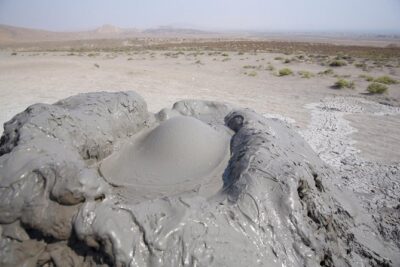
BEST Gobustan, Volcanoes & Absheron Fire Tour (Group or Private)
Read our review →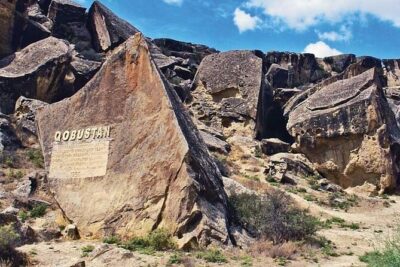
Gobustan, Volcanoes, Fire Temple and Yanardag Day Trip
Read our review →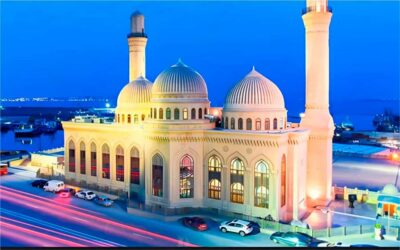
Gobustan-Mud Volcan-Fire Temple and Mountain Tour/Entrance inc
Read our review →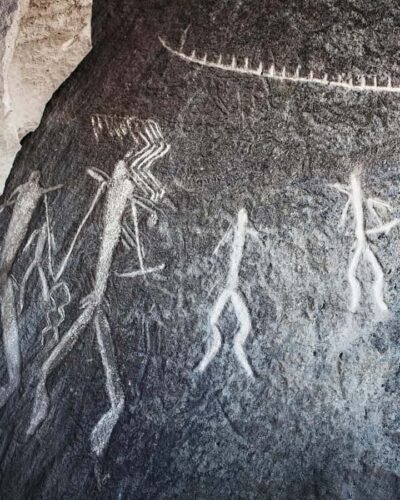
Gobustan Mud Volcanoes Temple & Entry tickets included
Read our review →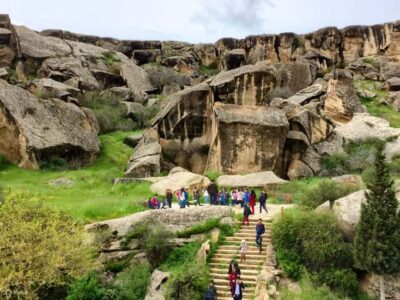
Gobustan-Absheron Tour with Hotel PICK UP and DROP OFF
Read our review →Browse the lists this tour appears in